


For many people, asbestos is simply something that might be hidden inside an old garage roof, ceiling coating or insulation board. It is often associated with danger, disease and expensive removal work. What many people don’t realise, however, is that asbestos is not a man-made material at all. It is a naturally occurring mineral that has existed within the Earth’s crust for millions of years. Long before it became a building material, asbestos formed naturally through geological processes involving heat, pressure and specific types of rock. Understanding where asbestos comes from, why it became so popular and how it eventually became recognised as a serious health hazard helps explain why it remains such an important issue for homeowners, businesses and property developers today.
Asbestos is the collective name given to a group of naturally occurring silicate minerals that form tiny fibres rather than solid crystals. These microscopic fibres are incredibly thin, flexible and remarkably strong. Unlike many other minerals, asbestos fibres can be separated into thousands of smaller strands without losing their strength. This unique structure gave asbestos properties that no other natural material could match during the industrial age. It could resist intense heat, withstand chemicals, provide excellent insulation and remain durable for decades without deteriorating.
Geological Formation of Asbestos Began Millions of Years Ago
The geological formation of asbestos began millions of years ago deep beneath the Earth’s surface. Certain magnesium-rich rocks underwent enormous pressure and heat during tectonic activity, gradually transforming their mineral structure into the fibrous materials we now recognise as asbestos. Over vast geological timescales these deposits became concentrated within mountain ranges and areas of volcanic activity. Large natural deposits were eventually discovered across several continents including Canada, Russia, South Africa, China, Brazil and parts of Europe. Some of the world’s largest asbestos mines operated for well over a century before concerns over public health eventually led to their closure.
There are six recognised types of asbestos, although three became the most commonly used throughout the construction industry. Chrysotile, often referred to as white asbestos, accounted for the vast majority of commercial asbestos production worldwide. It belongs to the serpentine family of minerals and has curly, flexible fibres that made it particularly suitable for weaving into fabrics and incorporating into cement products. Amosite, commonly known as brown asbestos, possesses straight, brittle fibres and was widely used in insulation boards and pipe lagging due to its excellent heat resistance. Crocidolite, or blue asbestos, has extremely fine, needle-like fibres and is considered one of the most hazardous forms because these fibres can penetrate deep into lung tissue when inhaled. Although less commonly encountered, tremolite, anthophyllite and actinolite also occur naturally and have occasionally contaminated other mineral products.
The Name Asbestos Itself Originates From the Greek Word Meaning “Inextinguishable” or “Unquenchable.”
Long before modern industry discovered asbestos, ancient civilisations were fascinated by its unusual characteristics. Historical records suggest that the Ancient Greeks observed that cloth woven from asbestos fibres would not burn when placed into a fire. The name asbestos itself originates from the Greek word meaning “inextinguishable” or “unquenchable.” This extraordinary resistance to flames seemed almost magical during a time when most materials could easily be destroyed by fire. Greek historians wrote about lamp wicks that never burned away and burial cloths that could be cleaned simply by placing them into flames rather than washing them.
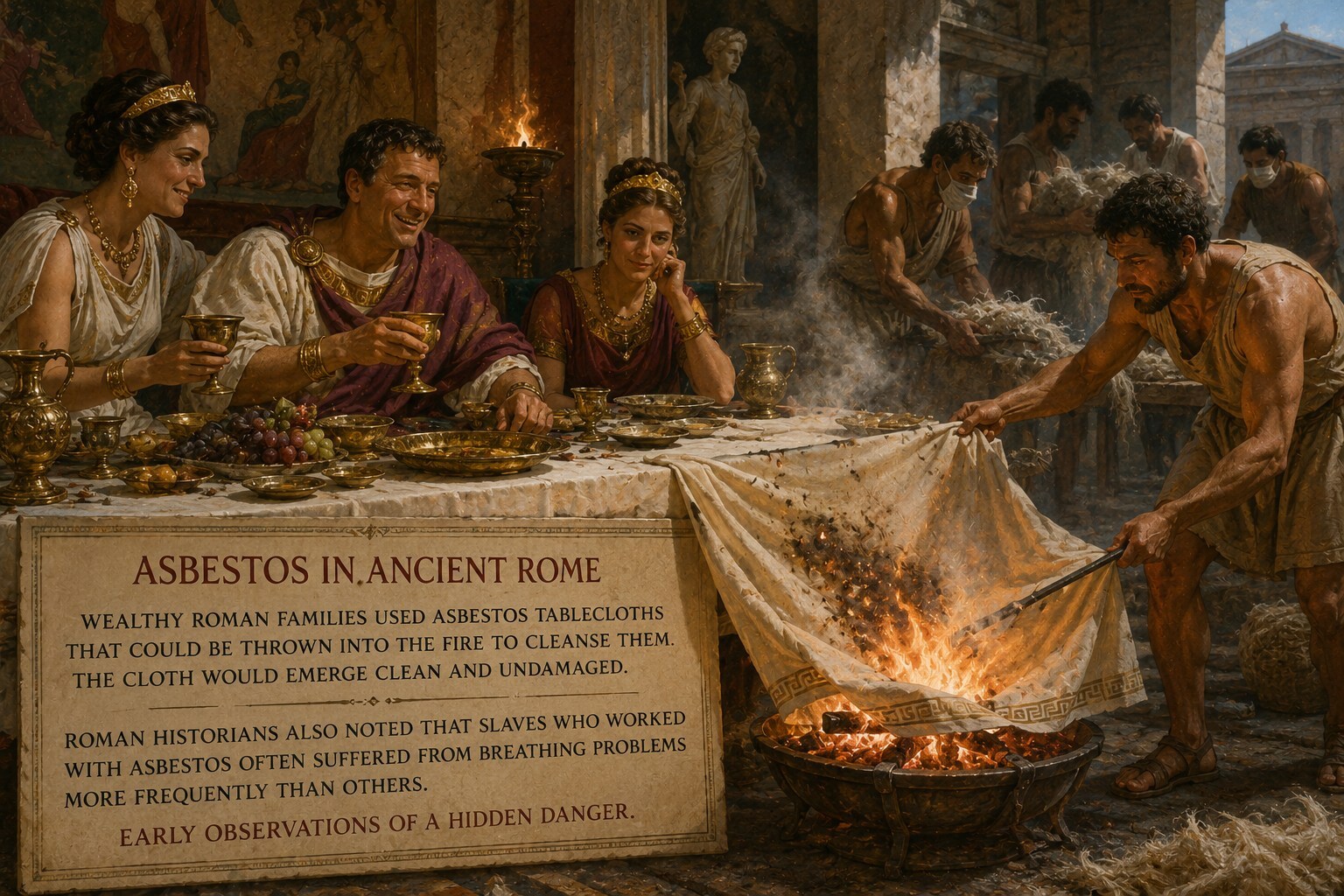
Asbestos in ancient rome
The Romans also recognised the remarkable qualities of asbestos. Wealthy families reportedly used asbestos tablecloths that could be cleaned by throwing them directly into a fire after banquets. Once the food residue had burned away, the cloth would emerge clean and undamaged. Roman historians also recorded observations that slaves who worked with asbestos appeared to suffer from breathing problems far more frequently than others. Although they had no understanding of microscopic fibres or lung disease, these may represent some of the earliest recorded observations of asbestos-related illness.
For many centuries asbestos remained a relatively rare curiosity because extracting and processing the mineral was difficult. Small quantities were used for decorative purposes, candle wicks, cremation cloths and various specialist applications, but widespread commercial use simply wasn’t practical. Everything changed during the Industrial Revolution. Advances in mining technology, transportation and manufacturing allowed enormous quantities of asbestos to be extracted from underground deposits. As factories expanded and steam-powered machinery became increasingly common, industries desperately needed materials capable of resisting high temperatures, reducing fire risk and insulating boilers, pipes and engines.
Asbestos quickly became one of the most valuable industrial minerals in the world. Manufacturers discovered that the fibres could be mixed with cement, plaster, textiles, plastics, adhesives and numerous other materials without significantly affecting production methods. The resulting products were stronger, more durable and dramatically more resistant to fire than many traditional building materials. As towns and cities expanded throughout the late nineteenth and early twentieth centuries, asbestos became integrated into almost every aspect of construction.
One of the greatest reasons for asbestos’ popularity was its ability to save lives from fire. Before modern fire regulations existed, large urban fires could devastate entire communities within hours. Buildings constructed largely from timber were especially vulnerable, and industrial premises containing boilers, furnaces and electrical equipment posed significant fire hazards. Architects and engineers welcomed asbestos because it provided an affordable way to improve fire resistance throughout buildings. Roofing materials, wall panels, ceiling tiles, insulation boards and pipe coverings all became significantly safer from a fire perspective when asbestos was incorporated into their manufacture.
The Second World War Accellerated Asbestos Production
The Second World War and the years that followed accelerated asbestos use even further. Britain faced an enormous demand for new housing, schools, hospitals, factories and public buildings following wartime destruction. Speed, affordability and durability became priorities throughout reconstruction. Asbestos cement sheets were widely used for garage roofs, agricultural buildings and industrial units because they were inexpensive, weather resistant and relatively easy to install. Asbestos insulating board became common in partition walls, service risers and fire doors. Sprayed asbestos coatings protected structural steelwork in commercial buildings, while pipe lagging insulated central heating systems and industrial plant.
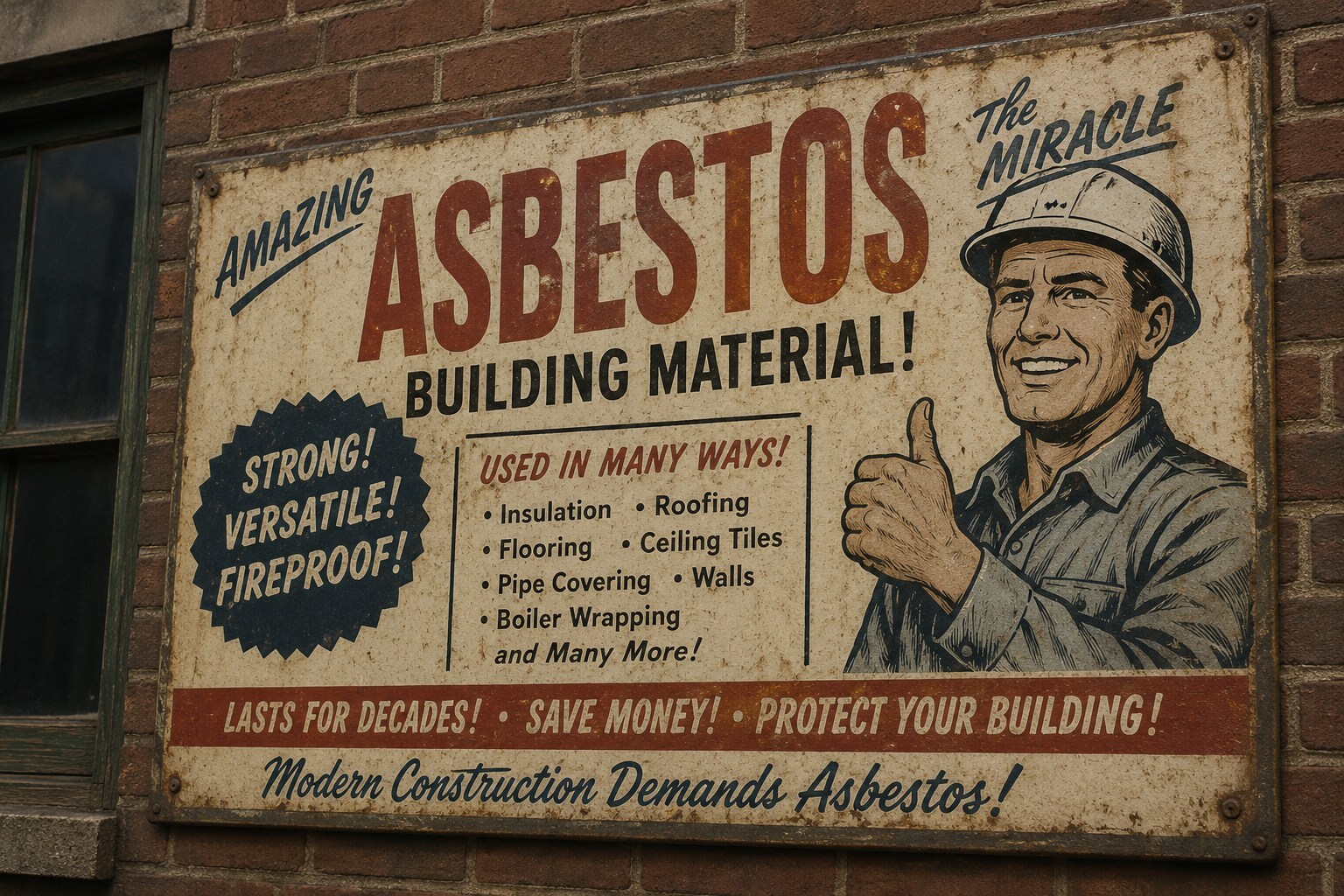
Asbetos advertisment promoting asbestos as a safe material
During the middle of the twentieth century asbestos was often referred to as a miracle material. Advertisements praised its strength, versatility and fire resistance, while manufacturers promoted its ability to last for decades without deterioration. Few construction professionals questioned its widespread use because the health risks were either poorly understood or, in some cases, deliberately downplayed despite increasing medical evidence.
Medical concerns surrounding asbestos did not appear overnight. As early as the late nineteenth century, doctors began noticing unusually high rates of respiratory illness among workers employed in asbestos textile factories and mining operations. Throughout the early twentieth century, researchers increasingly linked prolonged asbestos exposure with severe lung disease. By the 1920s and 1930s, the condition known as asbestosis had become medically recognised, describing permanent scarring of the lungs caused by inhaled asbestos fibres. Further research over subsequent decades established clear links between asbestos exposure, lung cancer and the aggressive cancer known as mesothelioma, which affects the lining surrounding the lungs and other organs.
One of the most alarming characteristics of asbestos-related disease is the exceptionally long latency period. Individuals exposed during building work or industrial employment may not develop symptoms for twenty, thirty or even fifty years after their initial exposure. This delay meant that many of the dangers were not fully appreciated until decades after asbestos had become firmly established throughout homes, schools, offices and factories.
As scientific evidence became overwhelming, governments around the world gradually introduced restrictions on asbestos use. The most hazardous forms, including blue asbestos and brown asbestos, were prohibited before white asbestos eventually followed. In the United Kingdom, all forms of asbestos were finally banned in 1999, bringing an end to more than a century of widespread commercial use. However, although new asbestos products can no longer be legally installed, millions of buildings constructed before the ban still contain asbestos today.
Modern asbestos surveys continue to identify asbestos in residential properties, commercial premises, schools, hospitals, industrial buildings and agricultural structures across the UK. Many materials remain perfectly safe if left undisturbed and in good condition, but damage, renovation work or deterioration can release microscopic fibres into the air where they may be inhaled. Because these fibres cannot be seen with the naked eye and remain suspended in the air for extended periods, specialist identification and appropriate management are essential whenever asbestos is suspected.
Understanding where asbestos comes from provides valuable perspective on why it became so widely used. Nature created a mineral with extraordinary physical properties that solved countless engineering and construction challenges throughout the industrial era. Its resistance to heat, chemicals and fire undoubtedly helped improve building safety in many respects. Unfortunately, those same microscopic fibres that made asbestos such an exceptional construction material also made it one of the most significant occupational and environmental health hazards ever encountered.
Today, asbestos is no longer viewed as a miracle material but as a legacy issue requiring careful management, professional expertise and strict safety procedures. With thousands of older buildings still containing asbestos-containing materials, understanding its natural origins and historical use helps property owners appreciate why asbestos remains present in so many structures built before the turn of the century. Professional asbestos surveys, testing and removal services continue to play an essential role in protecting homeowners, businesses, contractors and future generations from unnecessary exposure while allowing older buildings to be renovated and maintained safely.
